Translation workflow
(version 1.2)
What this is about
This workflow focuses on the process, not the tools. Software and file formats are secondary — what matters is that your team agrees on language choices before translating, produces a careful draft, and revises it thoroughly before moving to the following stage.
Stage 1 — Read and align
Before translating a single sentence, read the source text and agree on how to handle it.
Minimum reading: Introduction + Chapter 2. The full book is better, but these two establish the author’s register and the book’s core concepts.
Build your glossary. This template provides a starting list of terms that need agreed translations before you begin: core concepts, recurring metaphors, technical terms, pedagogical vocabulary. Work through it together and fill in your language column.
Why this matters: A term translated inconsistently across chapters — or translated differently by two contributors — is hard to fix retroactively. The glossary is cheap insurance. If you change your mind on a solution mid-way, the glossary makes a find-and-replace feasible; without it, you are hunting manually.
Keep the glossary updated throughout the process, not just at the start. For the Danish translation, we ended up incorporating the glossary in the Master Prompt for Danish.
Stage 2 — Translate the introduction and Chapter 1, and revise
The introduction and Chapter 1 establish the style you will carry through the rest of the book.
Option A — Human translation
Word and Markdown files with bilingual tables (English on the left, your language on the right, paragraph by paragraph) are ready for you at the end of this document. Work directly in the table. If you use Markdown we suggest a collaborative platform like Docmost or Outline, in which you can import .md files for each chapter.
Option B — AI-assisted draft
If you have a Claude Pro account (22.5 €/month), you can feed Claude the original text, the glossary, and the master prompt provided here, and get a first draft.
The AI draft is monolingual. For revision, feed your AI both the original chapter and the draft translation, and ask it to produce a two-column text with the original on the left and the translation synchronised on the right — paragraph by paragraph. This makes it easy to check against the original whenever something looks misunderstood or mistranslated.
A note of caution: a poor AI draft is worse than an empty page — and much worse than a draft spoken aloud by someone with a good command of the topic and of both languages. Use AI assistance only if you are prepared to revise the output critically. In our tests, Claude Pro was the only model that produced drafts worth working from; we do not recommend other tools for this task.
Either way: revise carefully. Whether the draft is human or AI-assisted, the introduction and Chapter 1 require thorough revision before you move on.
Stage 3 — Continue chapter by chapter
Once Introduction + Chapter 1 are solid, continue with Chapter 2.
If you are using AI assistance, feed Chapter 2 together with: the glossary, the master prompt, and your revised Chapter 1 as a style example. This significantly improves consistency.
Repeat for Chapters 3 and 4.
Stage 4 — External review
When all chapters are drafted and revised, ask two external reviewers to read the text. Brief them to focus on:
- Sentences where the meaning has been reversed or distorted
- Passages that are unclear in the target language even if technically accurate
- Terminology inconsistencies the glossary may have missed
Incorporate their feedback before finalising.
Stage 5 — Send it back
Send us the finalised file(s). Franz or Niels will handle the upload, formatting, and publication pipeline — that part involves some technical fiddliness that is not worth your time.
A word on AI assistance
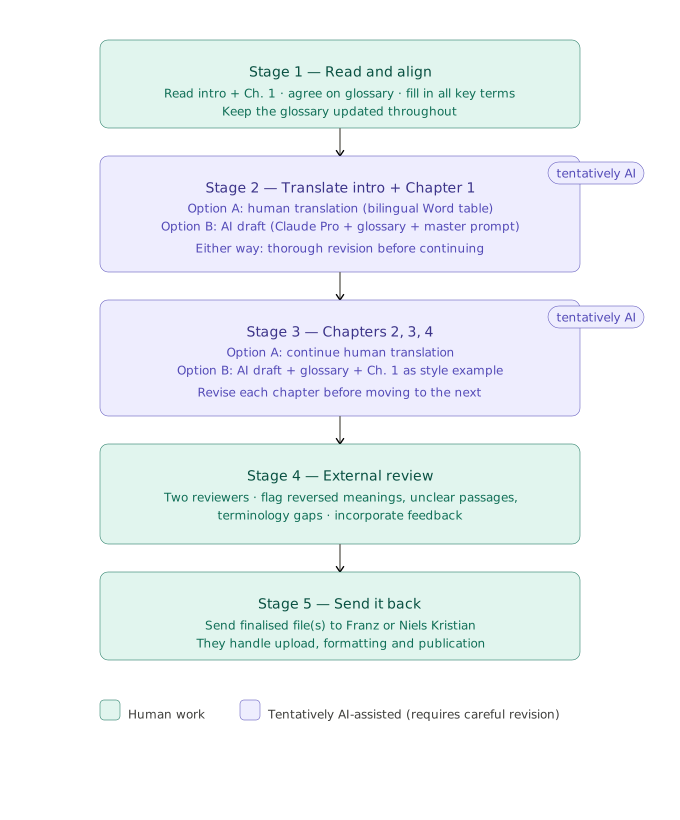
The flowchart below marks which stages can tentatively be supported by AI. “Tentatively” is the operative word: AI tools accelerate drafting but do not replace judgment. Every AI-generated passage needs a human reader who knows the topic and both languages well enough to catch what sounds plausible but is wrong.
Files ready for translation
Each section is available in four formats: original English as Markdown, bilingual two-column Markdown (English + blank column for your translation), and both as Word documents. The .md files are plain-text Markdown — paste them directly into Docmost or any Markdown editor and preserve the formatting symbols (e.g. **bold**, # Heading). The .docx files open in Word.
| Section | Original MD | Two-column MD | Orig. Word | Word two-column |
|---|---|---|---|---|
| Glossary template | — | glossary_EN_XX.md | — | glossary_EN_XX.docx |
| Ch. 1 — Cognitive Triage | ch1_EN.md | ch1_EN_XX.md | ch1_EN.docx | ch1_EN_XX.docx |
| Ch. 1 Worksheet | ch1ws_EN.md | ch1ws_EN_XX.md | ch1ws_EN.docx | ch1ws_EN_XX.docx |
| Ch. 2 — The Intelligent Gearbox | ch2_EN.md | ch2_EN_XX.md | ch2_EN.docx | ch2_EN_XX.docx |
| Ch. 2 Worksheet | ch2ws_EN.md | ch2ws_EN_XX.md | ch2ws_EN.docx | ch2ws_EN_XX.docx |
| Ch. 3 — The Cognitive Gym | ch3_EN.md | ch3_EN_XX.md | ch3_EN.docx | ch3_EN_XX.docx |
| Ch. 3 Worksheet | ch3ws_EN.md | ch3ws_EN_XX.md | ch3ws_EN.docx | ch3ws_EN_XX.docx |
| Ch. 4 — The Intelligent Simpleton | ch4_EN.md | ch4_EN_XX.md | ch4_EN.docx | ch4_EN_XX.docx |
| Ch. 4 Worksheet | ch4ws_EN.md | ch4ws_EN_XX.md | ch4ws_EN.docx | ch4ws_EN_XX.docx |
| Front matter | front_EN.md | front_EN_XX.md | front_EN.docx | front_EN_XX.docx |
| Introduction | intro_EN.md | intro_EN_XX.md | intro_EN.docx | intro_EN_XX.docx |
| References, appendix, back matter | ref_EN.md | ref_EN_XX.md | ref_EN.docx | ref_EN_XX.docx |